
I have always loved the idea of stations, students working collaboratively, and students demonstrating their ability to be independent learners. Early on in my teaching career, I believed that since my students were 8th graders, they could handle and understand how to do stations with minimal instruction. However, within my first year I quickly realized that this was not the case. Students, even older students, rely on explicit instruction of expectations and what to do when transitioning.
What does each station look like?
Recently, I created a lesson using stations that focused on gravity and the models of gravity. In this activity, I had four stations total: three of them being independent or collaborative, one of them being guided with me.
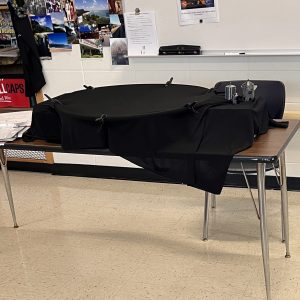
Teacher-Led Station: Hula Hoop Gravity

This station utilized a physical model of gravity which was constructed from a hula hoop, some fabric, and some clips to hold it all together. The fabric represented spacetime. Once the group of students arrived, I started asking them the guiding questions, beginning with “what does the fabric in our model represent?” to which the majority responded space or spacetime. “What do the masses represent?” Objects with mass in space! “What do the marbles represent?” Satellites!
Once we established and labeled every object in our model, we began our demonstration. Each student was instructed to grab a single marble from the bin and hold onto it. Afterwards, we ran through some scenarios with different masses in the middle of our fabric to see how it warps spacetime, which mass was easier to orbit, and so forth.
When students are in a smaller group, they tend to ask more thoughtful and intriguing questions than when in large group instruction. This is one of the hallmarks of the stations activities because students are more comfortable which lowers their stress and anxiety about asking questions.
Video Station

One station used a Nearpod video which had questions every couple minutes to check for understanding as students watched. The nice thing about Nearpod is that you are able to get the data and reports about each student that completed your assignment. This holds students accountable for both their actions, whether they are or are not doing the station, and their knowledge of the content.
Modeling Station

I am a huge proponent of constructing models of scientific concepts. Students have many strengths and some students strive when given an artistic way to represent their understanding. For this station, students were asked to draw a model of gravity with a central object and an orbiting object. Labels are important too! Once the model was drawn and labeled, students then had to write an explanation on the back so that anyone who looked at the model could better understand what it was about.
Definitions Station

I love using guided notes, anchor charts, and having students construct their own definitions for our academic vocabulary we use daily. I have many students who speak multiple languages so given them, and everyone, the opportunity to demonstrate their vocabulary knowledge and construct their own definitions is vital for me as a teacher. I want to make sure that they are able to explain a concept without using the provided definition.
At this station, there were six vocabulary words written on a poster. Each student in the group had to write a definition for each question. After everyone had written their definitions, the group had to discuss the pros and cons of each definition and lastly, choose the definition that best fit the vocabulary word.
Setting Clear Expectations
The key to the stations activities is to have clear expectations. After I explain what each station is about, I go over the expectations. The three basic expectations for my classroom are: be respectful, be responsible, and be safe.
Be Respectful
How does being respectful look during this activity? That depends on what station you are at. For example, if you are at the teacher-led station, being respectful means that you are being an active participant, listening to others, waiting for instructions, and generally being nice to others.
At the other stations this may be different. For the definitions station, being respectful means that you are not putting down others, you are being a collaborative group member, and you are assisting those that may need help. At the video station, being respectful would mean using your headphones or quietly listening to the video with closed captions on, and letting the people around you focus. When modeling, being respectful would mean sharing materials with your group members, focusing on your model and not distracting others, and keeping your hands to yourself and your materials.
Be Responsible
What does being responsible look like? Generally speaking for the classroom, it means to clean up after yourself, be on task, and take ownership over your actions. These three main principles still apply to all the stations, but explicitly stating how you can be responsible at each station is important.
For example, at the teacher-led station, being responsible would mean keeping track of your marble, holding onto your marble when told to, and waiting for instructions before acting. If your marble were to fly out of the gravity simulation, then being responsible would mean grabbing your marble off of the ground, not grabbing a new one!
At the other stations, similar expectations are stated as well. For modeling, students are responsible for cleaning up after themselves, putting the materials away in the correct spots, and leaving the station cleaner than when they arrived. For definitions, students are responsible for being on task and keeping the definitions accurate and appropriate. For the video, students are responsible for being on task, their volume level, and not distracting others.
Be Safe
Since stations are an activity in which students are moving about the classroom, it is important, in my eyes, to keep their safety as a top priority. The basics – hands and feet to yourselves – go without saying, right? If you’ve ever been in a school, you know that this rule needs to be restated constantly!
For every station, it is stated to be safe and what safety looks like. Did a marble fall on the ground? Pick it up so no one slips on it. Did a marker fall on the ground? Same deal; pick it up so no one slips.
One thing I always emphasize with my students is that there is no need for shoving or bumping people. There is always plenty of room and the groups are a fourth of your class size (for me I have around 30 kids per class so my groups range from 7-8 students).
Why Should I Do Stations?
If you made it this far and you’re wondering “Why should I do stations? They seem like a hassle!” then please consider the following.
Having small group instruction allows for students to be more open to having deep conversations about the content. It also allows students to feel more comfortable since they aren’t sharing their ideas with the whole class and feeling that pressure.
In addition to this, you are better able to differentiate for each group based on their needs, their interests, and guide them to the conversations that you, as the teacher, want them to have and the conversations they want to have.
Once you get the routine of how you want stations to run with your students, it becomes a well oiled machine. Over time, there is less need for explicit instruction of the instructions and expectations. You will find students loving the independence to learn on their own but also loving the small group interactions with you.
If you decide to give stations a try or want to try stations again now knowing how to get started, I would love to hear how it went for you!
-Teaching with Mr. Tim

 Teaching with Mr. Tim