Teacher’s Guide: IM Grade 8 Math™ Unit 1: Rigid Transformations

Introduction

If you are like me, you are figuring out the best way to teach your eighth graders their favorite subject — math. Additionally, you may also be like me if you use the Illustrative Math: IM Grade 8 Math™ curriculum. Let’s take a journey to walk through how to make the first unit of eighth grade manageable, fun, and most importantly, accessible, for your students!

Lessons 1 – 10 : Rigid Transformations

Before I start any unit, I take a look at the necessary vocabulary that students are going to need to know from prior units or years. Then, I look for what new vocabulary they are going to learn and use throughout the unit. To help you in your teaching journey, I have created some scaffolded notes that align to the IM Grade 8 Math™ curriculum!

My biggest advice for teaching using this curriculum is to follow the format of think, pair, share. How I structure this is as follows:


Think
In my classroom, we call the “think” time Quiet Think Time. This makes the message clear that students are expected to be quiet during at the start to allow everyone time to think. Depending on the question, this quiet think time can be anywhere from 20 seconds to 40 seconds. I find that this allows enough time for students to at least start the problem if not completely answer the question and come up with an explanation.


Pair
I call this Turn and Talk. Again, this makes it clear that the students are expected to turn to their neighbor and talk about their answers. Making these expectations explicit leaves no gray area for students to wander through. I find that the majority of tables do share their answers and explanations well because they had sufficient time to think about their answers first.


Share
This is where the type of question dictates what response you are looking for. Is the question a multiple choice question? Then ask students to raise their hands to show their choice! Is the question “this” or “that”? Then have them move to two sides of the room to show their answers! Is the question open ended and requires some explanation? Then have students share out their answers and explanations!

A lot of the opening questions and questions you will encounter in these lessons are more open ended. This is the nature of rigid transformations since there are endless ways to go from the pre-image to the image. Since there are so many ways to arrive at the same answer, having the students share their answer and how they got their allows for everyone to think in a variety of ways and ways that they may not have even seen before.

While teaching this unit, I found that students required for practice with rigid transformations. The provided practice problems were not enough for students to master the standard. Due to this, I created a study guide for the mid-unit assessment and the end-of-unit assessment.

These study guides are aligned to the assessments in the curriculum and give students additional practice. I have found that the students who complete the study guides are more confident in their answers, are better prepared for the assessments, and can assist their peers in figuring out the problems.

These study guides were a game changer for me because students will always have something to do if they finish their practice problems early. Additionally, in order for my students to retake their summative assessments they must complete the study guide, have me check their answers, and we talk through any questions that they may have gotten wrong. This allows for a more reflective experience for myself and my students.

Lessons 11 – 17 : Congruence

The second half of this unit revolves around shape and angle congruence. I found that a lot of my students did not have the necessary vocabulary to answer a lot of the questions about different types of polygons. I asked my students “what is a rhombus?”… no response. I told my students “draw a parallelogram”… I got every shape but a parallelogram. That’s when I knew I needed to give my students some scaffolded notes on different types of polygons and how they are related.

The curriculum only teaches a handful of angle pairs– just the basics to get by. While that is fine, I found that students were making the connections to more complex angle pairs. An example of this is that you could go from a vertical angle to an alternate interior angle, or you could have a corresponding angle. I also noticed that sentence structures for writing the angle pair proofs was not easily accessible in the provided curriculum. Therefore, I had students practice the sentence structure the practice problems and the study guide for this part of the unit.

I like to make the learning process as fun and engaging as possible. I created a trading card-like game where students use rigid transformations to battle monsters. If you want to level up your review activities, check out the review trading card game below.

How to Incorporate Movement in your Classroom

More than ever, students need to MOVE. With decreasing attention spans and an increasing need for stimulation, students need movement in order to stay engaged in the academic content in the classroom. 

How can we include movement in the classroom?

As an entry point, any worksheet can be made into a kinesthetic activity. If you have twenty problems on a worksheet, split the questions up and put them on different sheets of paper then display them around the room. This can be easy, quick, and doesn’t need a ton of prep but the pay off can be great!

A little more intense of an activity would be to do stations around the room. The stations could each have a set of questions about a certain topic or the stations could each have a different sub-activity to complete. One of my favorite things to do at a station is to have some questions posted on the wall, typically five or six. Then, students answer the questions and complete a color-by-number activity to reveal either a code or an image. This also helps keep students engaged in the activity since it may be different from what they are doing in other classes. 

Lastly, and one of my favorites to do, is a scavenger hunt. 

How to incorporate scavenger hunts

Scavenger hunts can be some of the most engaging activities you can do in your classroom. They help students foster curiosity, interdependence, collaboration, and of course, they are moving around the room. Scavenger hunts also make the learner more fun for the students. These activities could include riddles to where the questions or objects are hidden or it could be more of a hide-and-seek activity where the students just need to find the questions or objects on their own!

My most recent, and most successful, example of a scavenger hunt that I did was my Kauai Field Cricket scavenger hunt. For this activity, I hid over a hundred paper crickets around my room. Some of the crickets were on the ceiling, some were behind sinks, some were under tables, and some were even under tissue boxes! Students were tasked with finding and identifying if the crickets had a parasite or if they were parasite free. They were given ten minutes to do so and holy cow, did they hunt for those crickets!

Cricket without Parasite
Cricket with Parasite

After the time was up, we had a discussion as a class to see what our tallies were for each type of cricket. A lot of students did not find all of the crickets (which is definitely ok!) but a lot of them were in the right ballpark. After we collected and corrected the data, we constructed some data tables to display the collected data then we graphed our results.

Students were more engaged with the harder tasks of constructing data tables and graphs because they collected the data themselves. This created more ownership over their education and learner which fosters better understanding of the content and more appreciation for the learning.

If you would like to check out the resource that I used, it will be linked here.

I hope your school year is going well! If you have any questions, please feel free to reach out on TPT.

Thank you,

-Mr. Tim

Prepping for Spring Break

It’s almost that time of year again. The time when the winter drag turns into the spring sprint. For me, the weeks before spring break are always packed with assessments, standardized tests, and whether you love them or not, field trips.

So what is the best way to prep for the break? Are there strategies or ways to improve the experience before break or after you get back? That’s what we are here to talk about!

What do I do before break?

That’s the question we’ve all been asking— what do I need to do before break so that I can actually enjoy my break? For me, I need to be sure there are no loose ends going into a break otherwise I will only focus on those unfinished tasks. Therefore, I need a checklist of tasks that need to be done before spring break starts.

Standardized Testing

Spring is the time for warmth, happiness, and standardized tests. Growing up, standardized tests always gave me anxiety and that remains true today. The way in which I feel prepared and ready for proctoring the standardized tests is to make sure I’ve completed the training ahead of time, have a schedule of testing periods, and make sure my students understand the procedures for the testing period. 

Additionally, I like to make sure my students have a snack or breakfast provided to them before the tests. Since my school tends to not do this, I always plan to buy and distribute the nutritious foods to my students. 

Wrapping up Assessments

My biggest fear about breaks is always the loss of momentum when teaching a unit or module. Due to this, I always plan out my assessments thoughtfully so that all of my students can complete the final assessment before break to the best of their ability. Some students leave super early for spring break and some students need more than a class period to complete a test. With these factors, it’s always safe to assume that you may need a couple buffer days before the actual break. 

My break doesn’t officially start until a Friday afternoon. So, as a buffer, my unit assessment will occur either on Tuesday or Wednesday so that even if a student if leaving a couple days early, they can still complete the assessment to the best of their ability.

Field Trips

Field trips… When done correctly, they can be the most magical thing. When done incorrectly… well we have all been on a field trip where it may not have gone so well. The best way to feel prepared for a field trip is to actually prepare for a field trip.

Make those rosters, make a solid itinerary, make sure students understand the expectations and procedures for the field trip. Most importantly, have a teacher buddy that’ll make the field trip that much better! 

Planning for After Break

The most reassuring feeling is having a set-in-stone plan for when you come back from break. Knowing what you are teaching and what activities you will do makes break that much more enjoyable! No need to have those Sunday scaries or worry about finding a last minute lesson plan for Monday.

What do I do during break?

Relax! This is your time to breathe, kick back, and enjoy every second of break.

What do I do after break?

Harvest the fruits of your labor! You have a lesson plan all set for your first day (maybe even week) of school— that work before break pays off!

Welcome to the Spring Sprint! You only have a few more months until the end of the school year. I don’t know about you, but this year has flown by, had its ups and downs, but I wouldn’t change it for anything. 

If you are looking for resources for your classroom, check out my TPT store!

Have a fantastic few weeks before spring break!

-Mr. Tim.

The Second Semester Reset

Now that the second semester for a lot of us has begun, you may be like me and want to do a reset. Bring it back to the basics, reset the mood in your classroom, and bring spirits back up.

What does the reset look like?

The classroom reset depends on you, your students, and what you want your classroom to look like. I personally view my classroom as a shared space. Meaning, that I value my students’ input into the classroom with art work, class work, and student creations hanging on my walls. I love the student-centered approach to the classroom environment and teaching. 

I personally am looking to reset some expectations, procedures, and try to include more SEL and student belonging content into my classroom. 

Expectations

This year over any other year, I’ve noticed my students needing more and more reminders about being safe, responsible, and respectful to each other and the materials. For my second semester reset, I’m looking to reinforce these expectations throughout the classroom, throughout each lesson and teaching them what it looks like for each activity, and having them practice these expectations occasionally. If you want to know how these expectations work during stations or centers activities, click here to visit my How To Create Engaging Stations post.

Procedures

I teach middle school, meaning that my students are fairly good with daily routines. However, the procedures that occur weekly, monthly, or intermittently are often forgotten. The one exception is my bathroom pass procedure. For some reason, my students always forget to sign out and take the pass with them! 

A plan that I am looking to implement for this second semester is to reinforce the sign out procedures and change the location of my passes. Currently, my passes are by the door which makes it easy to just grab and go, or forget and go. I am planning on moving the passes towards the front of the room by me so that students can grab the pass and I can remind them to sign out which will also be located up front by the passes

For the procedures that only occur every so often, like having a pep rally, going to the auditorium for an assembly, or having a guest speaker, I am planning on setting some time aside to do some practice. Meaning, on a day that is available, my students and I may practice walking to the gym or the auditorium, quizzing them on their seating locations, and role playing having a guest speaker in the classroom. 

SEL and Student Belonging

I am a strong believer in having strong relationships with your students, knowing who they are as people, and learning how to create the safest and warmest classroom environment. One way in which I try to promote student belonging is by displaying their work on my walls, having them choose a say in the color of my lights, and giving them choices.

In the past I had an art wall, even though I am not an art teacher, simply because I had so many students that wanted to show their work off! I love every piece of art I receive and want the students to feel proud of their work. That is one thing I am planning on bringing back this semester.

Incorporating social and emotional learning into my instruction is another way in which I hope to reset my classroom. Teaching about working with others, managing emotions, and dealing with possible conflicts is essential in order to create a solid foundation for the positive classroom environment. 

How can I reset my classroom?

That depends on what your goals are for your classroom! What do you want to change mid-year? What’s already going well for you this year? If something is going well, don’t change it! But if you feel like something needs to change, then let’s talk first steps.

What are my first steps?

Make a Manageable Goal

I’m all for lofty, big picture goals, believe me. However, we need to start with someone manageable. Something that you can do within the first week or month and feel successful with the goal.

This could be reinforcing how students behave in lines and practicing line basics. On the other hand, it could be reteaching students how to raise their hand to ask a question. You wouldn’t believe how many times I have to stop class to model and reteach how to raise your hand if you have a question— and I teach middle school! 

An example framework for the goal could be “I want 90% of my students to correctly sign in and out of the classroom this week.” This is a manageable goal because it only spans a week, it can be retaught if need be, and you have the data in front of you.

Set Clear Expectations

Clear expectations, for who? For you! How are you going to hold yourself accountable for achieving the goal? Persevering through a goal can be challenging when you have 30 kids or even 130 kids! How can you persevere to achieve your goal?

Use Your Resources

My teaching team is a valuable resource for me. I am constantly asking them if they are having similar instances happen or are seeing similar patterns with student behavior. If they are, we problem solve it together. If it is just happening in my classroom, that’s where the reset needs to happen most. Use your resources!

How to Construct Stations That Keep Students Engaged

I have always loved the idea of stations, students working collaboratively, and students demonstrating their ability to be independent learners. Early on in my teaching career, I believed that since my students were 8th graders, they could handle and understand how to do stations with minimal instruction. However, within my first year I quickly realized that this was not the case. Students, even older students, rely on explicit instruction of expectations and what to do when transitioning.

What does each station look like?

Recently, I created a lesson using stations that focused on gravity and the models of gravity. In this activity, I had four stations total: three of them being independent or collaborative, one of them being guided with me. 

Teacher-Led Station: Hula Hoop Gravity

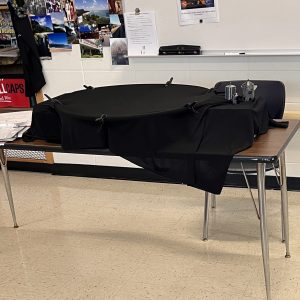
This station utilized a physical model of gravity which was constructed from a hula hoop, some fabric, and some clips to hold it all together. The fabric represented spacetime. Once the group of students arrived, I started asking them the guiding questions, beginning with “what does the fabric in our model represent?” to which the majority responded space or spacetime. “What do the masses represent?” Objects with mass in space! “What do the marbles represent?” Satellites!

Once we established and labeled every object in our model, we began our demonstration. Each student was instructed to grab a single marble from the bin and hold onto it. Afterwards, we ran through some scenarios with different masses in the middle of our fabric to see how it warps spacetime, which mass was easier to orbit, and so forth.

When students are in a smaller group, they tend to ask more thoughtful and intriguing questions than when in large group instruction. This is one of the hallmarks of the stations activities because students are more comfortable which lowers their stress and anxiety about asking questions.

Video Station

One station used a Nearpod video which had questions every couple minutes to check for understanding as students watched. The nice thing about Nearpod is that you are able to get the data and reports about each student that completed your assignment. This holds students accountable for both their actions, whether they are or are not doing the station, and their knowledge of the content.

Modeling Station

I am a huge proponent of constructing models of scientific concepts. Students have many strengths and some students strive when given an artistic way to represent their understanding. For this station, students were asked to draw a model of gravity with a central object and an orbiting object. Labels are important too! Once the model was drawn and labeled, students then had to write an explanation on the back so that anyone who looked at the model could better understand what it was about.

Definitions Station

I love using guided notes, anchor charts, and having students construct their own definitions for our academic vocabulary we use daily. I have many students who speak multiple languages so given them, and everyone, the opportunity to demonstrate their vocabulary knowledge and construct their own definitions is vital for me as a teacher. I want to make sure that they are able to explain a concept without using the provided definition.

At this station, there were six vocabulary words written on a poster. Each student in the group had to write a definition for each question. After everyone had written their definitions, the group had to discuss the pros and cons of each definition and lastly, choose the definition that best fit the vocabulary word.

Setting Clear Expectations

The key to the stations activities is to have clear expectations. After I explain what each station is about, I go over the expectations. The three basic expectations for my classroom are: be respectful, be responsible, and be safe.

Be Respectful

How does being respectful look during this activity? That depends on what station you are at. For example, if you are at the teacher-led station, being respectful means that you are being an active participant, listening to others, waiting for instructions, and generally being nice to others.

At the other stations this may be different. For the definitions station, being respectful means that you are not putting down others, you are being a collaborative group member, and you are assisting those that may need help. At the video station, being respectful would mean using your headphones or quietly listening to the video with closed captions on, and letting the people around you focus. When modeling, being respectful would mean sharing materials with your group members, focusing on your model and not distracting others, and keeping your hands to yourself and your materials.

Be Responsible

What does being responsible look like? Generally speaking for the classroom, it means to clean up after yourself, be on task, and take ownership over your actions. These three main principles still apply to all the stations, but explicitly stating how you can be responsible at each station is important.

For example, at the teacher-led station, being responsible would mean keeping track of your marble, holding onto your marble when told to, and waiting for instructions before acting. If your marble were to fly out of the gravity simulation, then being responsible would mean grabbing your marble off of the ground, not grabbing a new one!

At the other stations, similar expectations are stated as well. For modeling, students are responsible for cleaning up after themselves, putting the materials away in the correct spots, and leaving the station cleaner than when they arrived. For definitions, students are responsible for being on task and keeping the definitions accurate and appropriate. For the video, students are responsible for being on task, their volume level, and not distracting others.

Be Safe

Since stations are an activity in which students are moving about the classroom, it is important, in my eyes, to keep their safety as a top priority. The basics – hands and feet to yourselves – go without saying, right? If you’ve ever been in a school, you know that this rule needs to be restated constantly!

For every station, it is stated to be safe and what safety looks like. Did a marble fall on the ground? Pick it up so no one slips on it. Did a marker fall on the ground? Same deal; pick it up so no one slips. 

One thing I always emphasize with my students is that there is no need for shoving or bumping people. There is always plenty of room and the groups are a fourth of your class size (for me I have around 30 kids per class so my groups range from 7-8 students). 

Why Should I Do Stations?

If you made it this far and you’re wondering “Why should I do stations? They seem like a hassle!” then please consider the following. 

Having small group instruction allows for students to be more open to having deep conversations about the content. It also allows students to feel more comfortable since they aren’t sharing their ideas with the whole class and feeling that pressure. 

In addition to this, you are better able to differentiate for each group based on their needs, their interests, and guide them to the conversations that you, as the teacher, want them to have and the conversations they want to have. 

Once you get the routine of how you want stations to run with your students, it becomes a well oiled machine. Over time, there is less need for explicit instruction of the instructions and expectations. You will find students loving the independence to learn on their own but also loving the small group interactions with you.

If you decide to give stations a try or want to try stations again now knowing how to get started, I would love to hear how it went for you! 

-Teaching with Mr. Tim